

According to the ADA Health Policy Institute, 72.5% of U.S. dentists owned their practices in 2023—down from 84.7% in 2005. For early-career associates, the gap is sharper: as of 2021, only 9.5% of dentists under 30 owned a practice, down from 25.4% in 2005.
You’re producing strong numbers, building patient relationships, and quietly wondering, when does this become mine? The buy-in process feels like a black box. This post maps the exact pathway—step by step, with verified facts and no guesswork.
Why is dental practice ownership in Michigan harder than it looks?
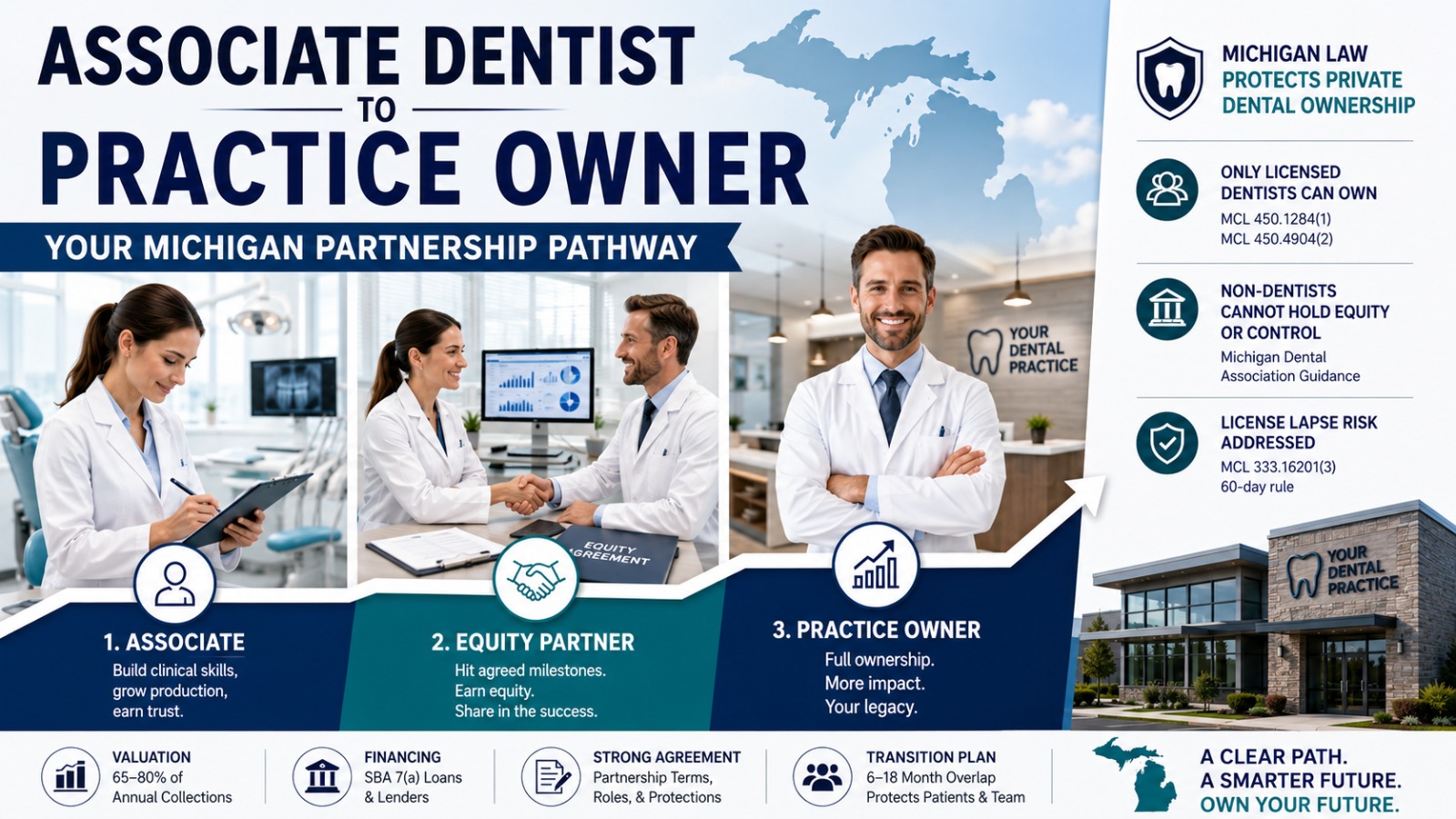
Michigan law restricts who can legally own a dental practice, and the rules are more specific than most associates realize. Under MCL 450.1284(1) of the Business Corporation Act, every shareholder of a professional corporation must hold an active Michigan dental licence. Under MCL 450.4904(2) of the Michigan LLC Act, the same applies to all members and managers of a professional LLC.
That means three things in practice:
-
No silent investors. A non-dentist cannot hold equity in your practice entity.
-
No DSO outright ownership. Corporate dental chains operate in Michigan through management service agreements (MSAs) — the licensed dentist remains the legal owner of the clinical entity.
-
Your partner must be a licensed Michigan dentist. Any co-ownership structure requires a licensed dentist on both sides.
One risk most associates miss: under MCL 333.16201(3), a dental license not renewed within 60 days of expiration is considered null and void. Because MCL 450.1284(1) requires all shareholders to stay actively licensed, a lapsed partner license creates an immediate ownership eligibility issue. Your Michigan dental partnership agreement must address this explicitly—with a defined cure period, buyout mechanism, or restructuring process.
This framework is actually a protective advantage. It limits corporate consolidation and keeps private dentist-to-dentist partnerships the dominant model in Michigan.
What is an equity associateship, and is it right for you?
An equity associateship is a structured arrangement where an associate earns a stake in the practice over time—before completing a full buy-in. It’s a trial partnership with contractual teeth.
Here’s how it works:
-
You join as a producing associate — standard compensation, no ownership yet.
-
You hit agreed-upon production or timeline milestones—locked in writing before day one.
-
Sweat equity accrues — your contributions reduce the eventual buy-in price.
-
You transition to partner or full owner — buying a percentage or the whole practice.
PARAGON Dental Practice Transitions, one of Michigan’s most active practice consultancies, describes equity associateships as a preferred pathway for both retiring owners and growth-focused associates, consistently leading to co-ownership or full practice ownership.
Every milestone, equity percentage, valuation method, and exit term must be in writing before you start. A handshake deal is not an equity associateship — it’s a promise with no enforcement.
This structure suits associates carrying dental school debt. The ADEA reports that the average indebted graduate in the Class of 2024 carried $312,700 in education debt. Building financial reserves before a full buy-in is not a delay — it’s a strategy.
How does the dental practice buy-in process work in Michigan?
The buy-in process follows a clear five-step sequence. The details at each stage determine whether you get a fair deal or an expensive lesson.
Step 1 — Get an independent valuation. For dentist-to-dentist sales, industry benchmarks consistently place Michigan practice values at 65–80% of annual collections, adjusted for overhead, patient retention, technology, and lease terms. Always use an independent dental CPA — not the seller’s accountant.
Step 2 — Structure the deal. A partial buy-in (30–50% ownership) suits most associate-to-owner transitions. You gain real equity and decision-making authority while the existing owner provides continuity for patients and staff. A full buy-in means 100% acquisition, with the owner exiting fully or staying through a transition period.
Step 3 — Secure financing. Most Michigan dentists use SBA 7(a) loans or dedicated dental practice lenders. Lenders typically require 2–3 years of tax returns, a clean credit profile, a formal business plan, and documentation of the practice’s production history.
Step 4 — Get the agreement right. Your Michigan dental partnership agreement must be drafted by a healthcare attorney with dental transactional experience — not a general business lawyer. It must cover ownership percentages, profit distribution, clinical and management roles, capital contributions, buyout triggers, a licence lapse provision under MCL 333.16201(3), non-compete terms, and dispute resolution.
Per the Michigan Dental Association, any arrangement giving a non-dentist effective control over clinical decisions violates state licensing rules — even if ownership percentages appear compliant on paper.
Step 5 — Run a transition period. Most Michigan buy-ins include a 6–18 month overlap where both dentists work side by side. This protects patient retention — the most fragile asset in any practice transition.
Timeline for Dental Practice Ownership in Michigan
Most Michigan associate dentists take 3–7 years to reach full ownership. The range depends on the pathway chosen.
Fast track (3–4 years): You enter with a signed equity associateship from day one, hit pre-agreed milestones, and begin the buy-in process at year three. This requires an owner already planning their exit.
Standard track (5–6 years): You work as a traditional associate, build savings, then approach the owner or find an external acquisition. This is the most common path.
Extended track (6–7+ years): You carry high student debt, reduce financial pressure through a DSO role first, then transition to private practice before pursuing ownership.
The ADA Health Policy Institute’s June 2025 research brief, Practice Ownership Trends in Dentistry: A New Look at Old Data, confirms ownership is delayed — not abandoned — for recent graduates. Among dentists who graduated before 2010, 63–70% owned practices within their first five to nine years. For the 2016–2020 cohort, that early-stage rate has dropped to 21%, but the data shows most dentists still reach ownership at a later career stage.
3 things to take away
1. Michigan’s laws protect private ownership. Non-dentists cannot own practices under MCL 450.1284(1) and MCL 450.4904(2). DSO structural control is limited. Private dentist-to-dentist partnerships remain the strongest long-term model.
2. The equity associateship is your lowest-risk entry point. With the ADEA-reported average debt of $312,700 for the Class of 2024, building reserves before a full buy-in is smart—and a properly structured equity associateship lets you do exactly that.
3. The agreement is everything. Detailed, attorney-reviewed, and inclusive of a license lapse provision under MCL 333.16201(3)—before day one.
Frequently asked questions
Can a non-dentist co-own my Michigan dental practice?
No. Under MCL 450.1284(1) and MCL 450.4904(2), all shareholders and members of a dental professional entity must be licensed Michigan dentists. Non-dentists cannot hold equity, even as silent partners.
How is a dental practice valued in Michigan?
Industry benchmarks place dentist-to-dentist sales at 65–80% of annual collections, adjusted for overhead, patient base stability, lease terms, and technology. An independent dental CPA should conduct the valuation.
What happens if my partner’s dental license lapses?
Under MCL 333.16201(3), a licence not renewed within 60 days of expiration is null and void. This creates an ownership eligibility issue under MCL 450.1284(1). Your partnership agreement must include a cure period, buyout trigger, or restructuring mechanism to address this.