

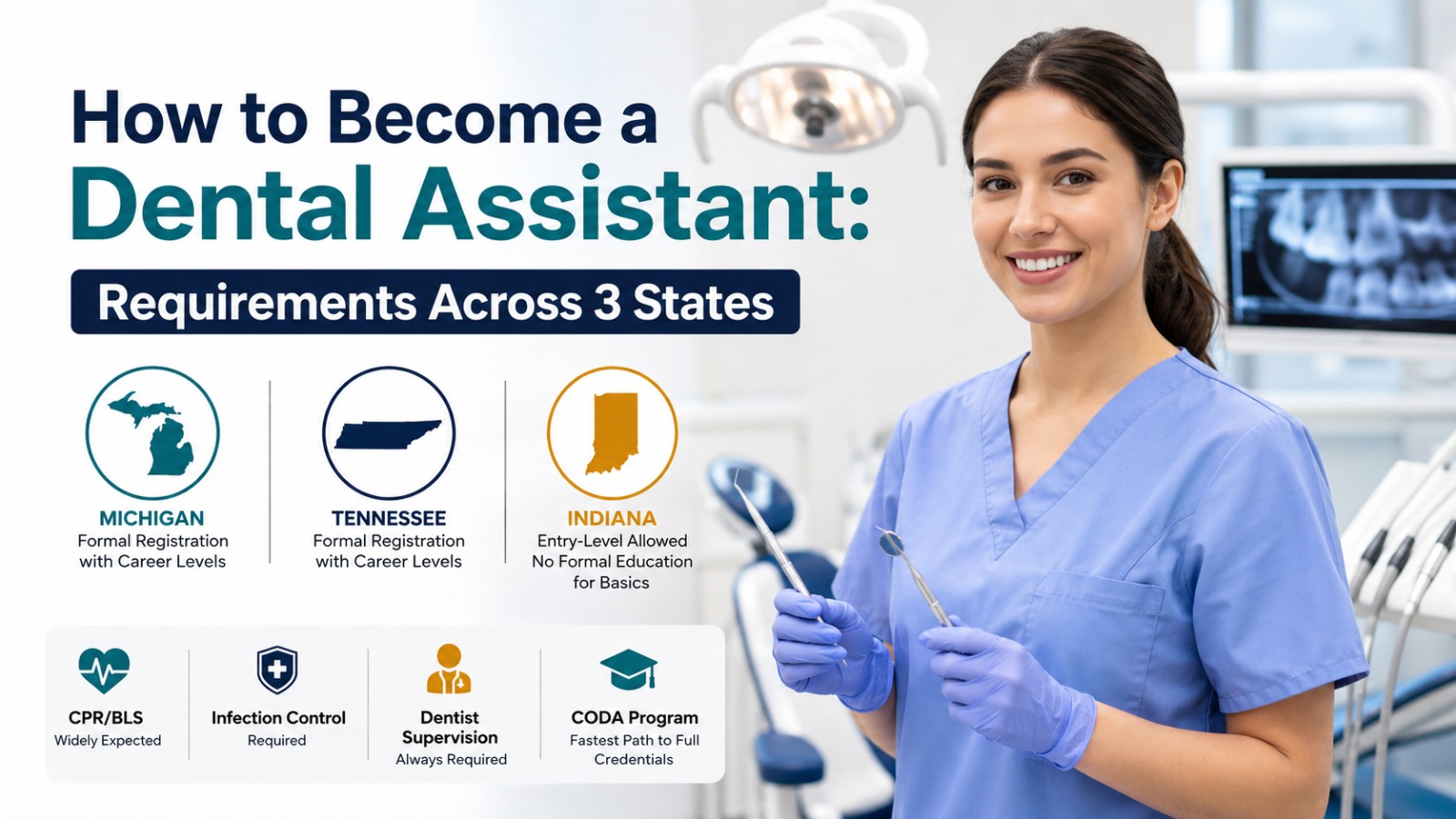
Requirements depend on your state. Michigan and Tennessee use formal registration with career levels. Indiana permits entry-level assistants without formal education, but requires a radiographic license for X-ray. A one-year CODA-accredited program is the fastest way to full credentials, with CPR/BLS widely expected from day one.
What Do All Three States Have in Common?
Before diving into each state, a few things are broadly consistent across Michigan, Indiana, and Tennessee:
CPR/BLS is required in Michigan and Tennessee for state registration, used in major Indiana certifications, and commonly required by Indiana employers.
Infection control training is a formal requirement for registered or expanded-duty dental assistants in all three states.
A supervising licensed dentist must be present when you perform clinical procedures, regardless of your certification level.
CODA-accredited programs unlock higher credentials, national exams, and broader clinical scope in every state.
One clarification worth making upfront: many employers across all three states prefer a high school diploma or GED, but this is a formal legal requirement only for Tennessee’s RDA registration. Indiana and Michigan do not mandate a diploma for entry-level duties.
Do You Need a Formal Degree to Become a Dental Assistant?
Not always—but completing one opens significantly more doors.
In Indiana, you can start working basic supportive duties under a dentist’s direct supervision with no formal education. In Michigan, an Unregistered Dental Auxiliary (UDA) can perform limited clinical tasks with just BLS certification and one hour of infection control training.
That said, a CODA-accredited dental assisting program (roughly one year) qualifies you to sit for the DANB Certified Dental Assistant (CDA) exam, satisfies radiography training requirements in multiple states, and makes you a far stronger candidate in any dental office. If you’re serious about this career, it’s the clearest path forward.
What Are the Dental Assistant Requirements in Michigan?
Michigan has a two-level system for dental assistants, each with distinct requirements and clinical scope.
What Can a Michigan Unregistered Dental Auxiliary (UDA) Do?
A UDA is an entry-level dental assistant working without state registration. Before a dentist can delegate any clinical tasks to a UDA, the UDA must:
-
Hold current BLS (Basic Life Support) certification for healthcare providers, with a hands-on component, renewed every two years.
-
Complete at least one hour of infection control training covering sterilization of handpieces, PPE use, and CDC infection control guidelines.
With those requirements met, a UDA can operate dental X-ray equipment (with approved radiography training), assist with orthodontic procedures, apply sealants and fluoride varnish, take impressions for study models, and temporarily cement and remove temporary crowns—under either direct or general supervision, depending on the specific task.
How Do You Become a Registered Dental Assistant (RDA) in Michigan?
To earn your RDA license from the Michigan Board of Dentistry, you must:
-
Be of good moral character.
-
Graduate from a CODA-accredited dental assisting program
-
Pass the board-approved written and clinical RDA examination (often administered as a national/practical exam accepted by the Board)
-
Hold current BLS (Basic Life Support) certification for healthcare providers, with a hands-on component.
-
Complete two hours of implicit bias training within the five years before registration (confirm current requirements and hours on the Michigan Board of Dentistry application page before submitting, as renewal requirements differ)
-
Complete a one-time training on identifying victims of human trafficking.
-
Pass a fingerprinting and criminal background check.
-
Apply for licensure with the Michigan Board of Dentistry.
Michigan RDAs can perform a broader range of clinical tasks than UDAs, including placing and carving amalgam restorations, removing sutures, assisting with nitrous oxide monitoring, applying in-office bleaching products, taking final impressions, and conducting preliminary examinations—many of which require additional approved coursework before performing.
What Are Michigan’s Radiography Requirements?
Michigan does not issue a separate state radiology license or certificate. To legally operate dental X-ray equipment, you must complete a dental radiography course substantially equivalent to one taught in a CODA-accredited program. That training record must be kept on file—it is what authorizes you to perform radiography, not a credential card.
What Are the Dental Assistant Requirements in Indiana?
Indiana takes a less-regulated approach than Michigan or Tennessee at the entry level, but draws a firm line regarding radiography and expanded clinical duties.
Can You Become a Dental Assistant in Indiana Without Any Education?
Yes—for basic supportive duties. Indiana does not require formal education or training to begin working as a dental assistant performing non-expanded duties. You work under the direct supervision of a licensed dentist, meaning the dentist is physically present in the facility while you provide care.
This makes Indiana one of the most accessible entry points into dental assisting in the Midwest.
What Does Indiana Require for Dental Radiography?
This is where Indiana draws a hard line. Before performing dental radiographic procedures, you must obtain a limited dental radiographic license from the Indiana Department of Health / Division of Radiology and Weights & Measures (not the Indiana Board of Dentistry, which governs expanded functions). The process typically requires:
-
Completing a CODA-accredited or Indiana Department of Health–approved radiography program.
-
Being certified as proficient by a licensed dentist or dental hygienist
-
Passing a qualifying exam — the DANB Radiation Health and Safety (RHS) exam is the standard pathway; some candidates may qualify via the DANB CDA or Department of Health–approved alternatives.
-
Applying to the Indiana Department of Health / Division of Radiology and Weights & Measures for your license
Student permits and provisional permits are available while completing your training program.
How Can Indiana Dental Assistants Earn Expanded Functions?
Indiana recognizes three expanded-duty qualifications beyond basic assisting: coronal polishing, applying topical fluoride/medicaments, and administering nitrous oxide. Each typically requires:
-
Either one year of employment in a dental practice or graduation from a CODA-accredited program
-
Completion of a board-approved training course:
-
Coronal polishing and topical fluoride: typically 5 hours didactic + 2 hours lab + clinical performance on five patients
-
Nitrous oxide: typically a 3-hour didactic and clinical demonstration on five patients under direct supervision
-
-
A signed competency affidavit from your supervising dentist, submitted to the Indiana State Board of Dentistry before you begin performing those duties.
Your certificate of completion will be displayed publicly in the dental office.
What Are the Dental Assistant Requirements in Tennessee?
Tennessee has the most clearly structured career ladder of the three states—three distinct levels that build on each other in a logical progression.
What Are the Three Levels of Dental Assistants in Tennessee?
Level 1 — Practical Dental Assistant: The entry point. Practical dental assistants work under the continuous direct supervision of a licensed dentist and can perform a wide range of supportive tasks: taking vital signs and medical history, placing and removing rubber dams, taking alginate impressions, fabricating and placing temporary restorations, processing radiographs (once separately certified), placing matrices, and more. No formal state registration is required at this level.
Level 2 — Registered Dental Assistant (RDA): To register as an RDA in Tennessee, you must:
-
Be at least 18 years old.
-
Hold a high school diploma or GED.
-
Complete a BLS/CPR course (Healthcare Providers level or equivalent)
-
Pass the Tennessee Board of Dentistry Ethics and Jurisprudence exam—a state-specific requirement that frequently catches out-of-state applicants off guard.
-
Apply for registration with the Tennessee Board of Dentistry.
RDAs can perform all practical dental assistant duties plus apply teeth whitening formulations under direct supervision.
Level 3 — RDA with Expanded Functions: This is where a Tennessee dental assistant’s clinical scope becomes genuinely substantial. RDAs can earn separate state certificates for:
-
Coronal polishing: Board-approved course with written and clinical exam
-
Sealant application: Board-approved course
-
Monitoring nitrous oxide: Board-approved course
-
Restorative and prosthetic functions: the most advanced and rigorous of the four; requires a minimum of two years of continuous full-time RDA employment in the three years before enrollment, plus a comprehensive Board-approved certification course that goes well beyond what coronal polishing training involves
Each area results in a separate certificate from the Tennessee Board of Dentistry. RDAs credentialed in other states may be eligible to apply directly for an expanded functions certificate without repeating training; contact the Board to confirm eligibility.
What Are Tennessee’s Radiography Requirements?
Tennessee requires that you hold RDA registration first before you can qualify to expose dental radiographs—a key difference from Michigan and Indiana. Once registered, you qualify through one of these pathways:
-
Complete a Tennessee Board-approved radiology certification course (which may be included as part of a Board-approved dental assisting program)
-
Complete comparable radiology training completed in another state.
-
Hold an active DANB CDA certification.
-
Pass the Radiation Health and Safety (RHS) component of the DANB CDA exam.
After qualifying via one of those routes, you apply to the Tennessee Board of Dentistry for your state radiology certificate.
How Do Michigan, Indiana, and Tennessee Compare at a Glance?
|
Michigan |
Indiana |
Tennessee |
|
|
Entry without formal education? |
Yes (as UDA) |
Yes |
Yes (as Practical DA) |
|
High school diploma required by the state? |
No (employer preference) |
No (employer preference) |
Yes (for RDA) |
|
Formal state registration system? |
Yes (RDA license) |
No (expanded duty certs only) |
Yes (RDA registration) |
|
Radiography credential? |
Training required; no separate state license |
State radiographic license required (issued by Indiana Dept. of Health) |
State radiology certificate required (RDA first) |
|
CPR/BLS required by state? |
Yes (for UDA and RDA) |
For DANB credentials; many employers require it |
Yes (for RDA) |
|
Background check required? |
Yes (for RDA) |
No |
No |
|
Implicit bias training? |
Yes (for RDA) |
No |
No |
|
Expanded functions available? |
Yes (with approved courses) |
Yes (3 areas) |
Yes (4 areas + state certificates) |
Requirements change periodically—always verify with your state board before applying.
What Are Dental Assistants Not Allowed to Do in These States?
Certain procedures are off-limits for dental assistants at every level across all three states. These include:
-
Diagnosing disease or creating treatment plans
-
Cutting hard or soft tissue
-
Removing calculus deposits or performing deep scaling or root planing
-
Administering local anesthesia (not permitted for dental assistants in MI, IN, or TN under current rules—though some other states do allow this for specially certified assistants)
-
Performing root canal procedures
-
Approving final occlusion and placing sutures (Tennessee explicitly restricts both for assistants; generally reserved for dentists across all three states)
When in doubt about any delegated function, check with your state board before performing it.
Ready to Start or Advance Your Dental Assisting Career?
Whether you’re finishing a CODA program, recently passed your state registration exam, or exploring what expanded function certifications could do for your career, the opportunity across these three states is real. The U.S. Bureau of Labor Statistics projects 8% job growth for dental assistants through 2033—faster than the national average.
MPM Dental supports dental practices across Michigan, Indiana, and Tennessee, and actively hires dental assistants at every experience level—from new graduates to credentialed RDAs ready for expanded clinical responsibilities.