

What Dental Assistants Actually Earn in Michigan Right Now
Dental assistant salaries in Michigan in 2026 vary depending on experience, certification, and location — but the direction is clear: wages are rising.
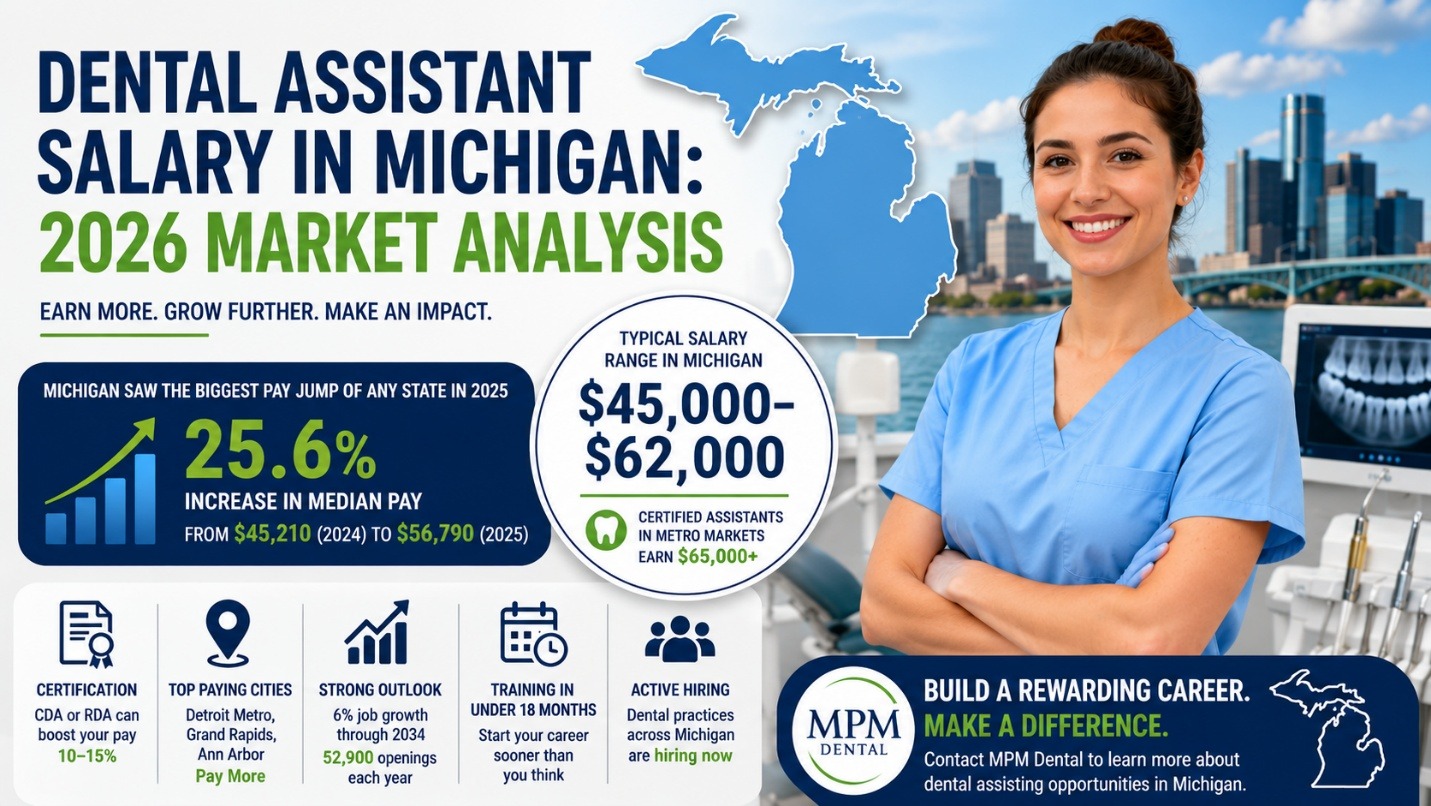
According to Glassdoor’s May 2026 data, based on 355 anonymously submitted salaries, most Michigan dental assistants earn between $45,904 and $62,178 per year, with the average at $53,122 and top earners at the 90th percentile clearing $71,532. The BLS-tracked state median, reported by Research.com, sits at $56,790 for 2025. The honest working range for most full-time Michigan dental assistants: $45,000 to $62,000, with real outliers on both ends depending on certification, specialty, and city.
Michigan Had the Biggest Pay Jump of Any State in 2025
This is the stat that changes the conversation. Michigan’s median annual wage rose from $45,210 in 2024 to $56,790 in 2025 — a 25.61% increase — according to Research.com’s 2026 dental assistant salary analysis. No other state came close; Kentucky was second at 11.27%.
Three factors drove that jump:
-
Dental practices competing aggressively for staff after pandemic-era workforce losses
-
Michigan’s aging population generating more patient volume, especially for restorative and preventive care
-
Cost-of-living adjustments hitting healthcare wages across the state
For anyone already working as a dental assistant in Michigan, that’s a meaningful raise. For someone still deciding whether to enter the field, it’s a clear signal that employers are paying attention.
Dental Assistant Salary by Experience Level in Michigan
Experience is the most reliable predictor of pay in dental assisting.
|
Experience Level |
Estimated Annual Salary |
|
Entry-level (0–2 years) |
$38,000 – $45,000 |
|
Mid-level (2–5 years) |
$46,000 – $54,000 |
|
Senior (5+ years) |
$55,000 – $65,000 |
|
Top earners / specialty roles |
$65,000 – $71,532 |
Most new assistants in Michigan start between $38,000 and $45,000. Offices that hire recent graduates from accredited programs typically start them at the higher end. At mid-level, assistants are taking X-rays, managing longer procedures without close supervision, and helping train new hires. That expanded responsibility reliably pushes pay into the $46,000–$54,000 range. Experienced assistants who move into specialty practices or lead roles regularly earn $55,000 to $65,000+.
Certified vs. Non-Certified: The Real Pay Gap
Getting certified is one of the highest-ROI moves available in this field. Nationally, Certified Dental Assistants (CDAs) earn about 15% more than non-certified peers — roughly $26/hour versus $22.50/hour.
In Michigan, the Registered Dental Assistant (RDA) credential carries a clear premium. Glassdoor’s May 2026 data puts the average RDA salary in Michigan at $62,038/year, with top earners reaching $73,605. That’s $5,000–$10,000 more per year than the general dental assistant average.
Certifications worth pursuing in Michigan:
-
CDA (Certified Dental Assistant) — issued by the Dental Assisting National Board (DANB)
-
RDA (Registered Dental Assistant) — Michigan state registration
-
Radiography/X-ray certification — often required by Michigan employers independently
-
Expanded Function Dental Assistant (EFDA) — higher-skill procedures, higher pay ceiling
-
CPR/BLS certification — standard requirement across nearly all Michigan offices
For full certification details, see DANB’s CDA and RDA certification requirements — the national authority for dental assistant credentialing.
Dental Assistant Pay by City in Michigan
Michigan’s metro areas pay more than rural markets consistently across every data source.
|
City / Region |
Typical Annual Salary Range |
|
Detroit metro |
$52,000 – $62,000 |
|
Grand Rapids |
$48,000 – $62,000 |
|
Dearborn / Warren |
$48,000 – $57,000 |
|
Ann Arbor |
$50,000 – $59,000 |
|
Lansing |
$46,000 – $54,000 |
|
Smaller / rural markets |
$38,000 – $46,000 |
Grand Rapids is one of the state’s strongest markets — Glassdoor reports a $53,036 average with a typical range of $45,837–$62,035. Ann Arbor, home to the University of Michigan Health System, anchors around $50,000–$59,000 for private specialty practices. The Detroit metro and Grand Rapids corridors pay $5,000–$10,000 more per year than smaller Michigan markets for equivalent roles.
Dental Assistant Training in Michigan
Most accredited dental assisting programs in Michigan take 9–12 months and lead to a certificate or diploma. Some community colleges offer associate degree programs that run 18–24 months. Either path qualifies you to sit for RDA registration and CDA certification.
Michigan has several accredited programs, including those at Oakland Community College, Ferris State University, and Delta College, among others. The Commission on Dental Accreditation (CODA) accredits programs nationally; graduates of CODA-accredited programs are eligible for DANB’s CDA exam.
For people weighing the investment: shorter training timelines (under 18 months), active hiring, and Michigan’s recent wage growth make dental assisting one of the more accessible entries into healthcare with strong near-term earning potential.
Job Outlook: Is the Market Hiring?
Yes — and the data backs it up. According to the BLS Occupational Outlook Handbook for Dental Assistants, employment is projected to grow 6% from 2024 to 2034 — faster than the average for all occupations — with approximately 52,900 openings projected nationally each year over the decade.
The broader context matters: 63.7 million Americans currently live in dental Health Professional Shortage Areas, and practices are actively competing to fill clinical support roles. That competition flows directly into better wages and faster hiring for qualified assistants. Michigan-specific hiring has stayed steady across metro and suburban markets, with general dentistry offices, DSO-affiliated group practices, and specialty clinics all continuing to post open positions.
What Actually Moves Your Salary Higher
-
Get credentialed. CDA or RDA certification adds 10–15% to your pay and opens specialty practice doors.
-
Target specialty practices. Orthodontic, oral surgery, and endodontic offices often pay $5,000–$10,000/year more for the same experience level.
-
Work in a DSO or larger group practice. DSO affiliation reached 16.1% in 2024. These organizations typically offer structured pay scales and defined advancement paths.
-
Choose your city deliberately. Detroit metro and Grand Rapids consistently pay more than smaller Michigan markets.
-
Consider a path toward dental hygiene. The Michigan dental hygienist average is approximately $74,699/year per Salary.com — about 31% above the dental assistant median. Many assistants use their clinical hours as the foundation for hygiene school applications.
Frequently Asked Questions
How much do dental assistants make in Michigan per hour?
Most Michigan dental assistants earn between $22–$30/hour in 2026. The Glassdoor average works out to approximately $26/hour. Certified assistants in metro practices can reach $30–$35/hour.
What is the starting salary for a dental assistant in Michigan?
Entry-level dental assistants in Michigan typically start between $38,000 and $45,000 per year (0–2 years of experience). Graduates of accredited programs hired by specialty or DSO practices tend to start at the higher end of that band.
Is dental assisting a good career in Michigan?
Yes, particularly in 2026. Michigan saw the largest dental assistant salary jump of any U.S. state in 2025 (25.6%), training takes under 18 months, and BLS projects 6% job growth through 2034. The work runs on standard daytime hours with limited overnight or weekend requirements compared to hospital-based healthcare roles.
How long does dental assistant training take in Michigan?
Most accredited certificate programs take 9–12 months. Associate degree programs run 18–24 months. Either qualifies you for RDA registration and the CDA exam through DANB.
Do dental assistants need to be certified in Michigan?
Michigan requires RDA (Registered Dental Assistant) registration for assistants who perform expanded duties. Radiography certification is also required by most employers, independently of RDA status. The CDA credential from DANB is nationally recognized and adds a salary premium even where not legally required.
Key Takeaways on Michigan Dental Assistant Compensation
Michigan dental assistant salaries are climbing, the job market is active, and certified assistants in metro markets are earning wages that weren’t realistic for this role even three years ago.
The 25.6% median salary jump Michigan saw in 2025 is the defining data point right now. Whether it moderates slightly in 2026 or holds, the direction is clear — practices are paying more to attract and keep good assistants.
The highest earners in this data are certified, experienced, working in specialty practices in Detroit, Grand Rapids, or Ann Arbor. The floor is entry-level, uncertified, and in a rural market. The gap between those two profiles is roughly $25,000–$30,000/year, and most of it is closeable through deliberate career decisions.
Data Sources
BLS Occupational Outlook Handbook — Dental Assistants (bls.gov)
Research.com — 2026 Dental Assistant Salary by State (research.com)
DANB — Dental Assisting National Board Certification (danb.org)
Glassdoor Michigan Dental Assistant Salaries (May 2026, n=355)
Salary.com Michigan Dental Assistant and Hygienist Benchmarks
Exploring a dental assisting career or looking for the right practice in Michigan? Contact MPM Dental to learn more about how we work with dental professionals across the state.