
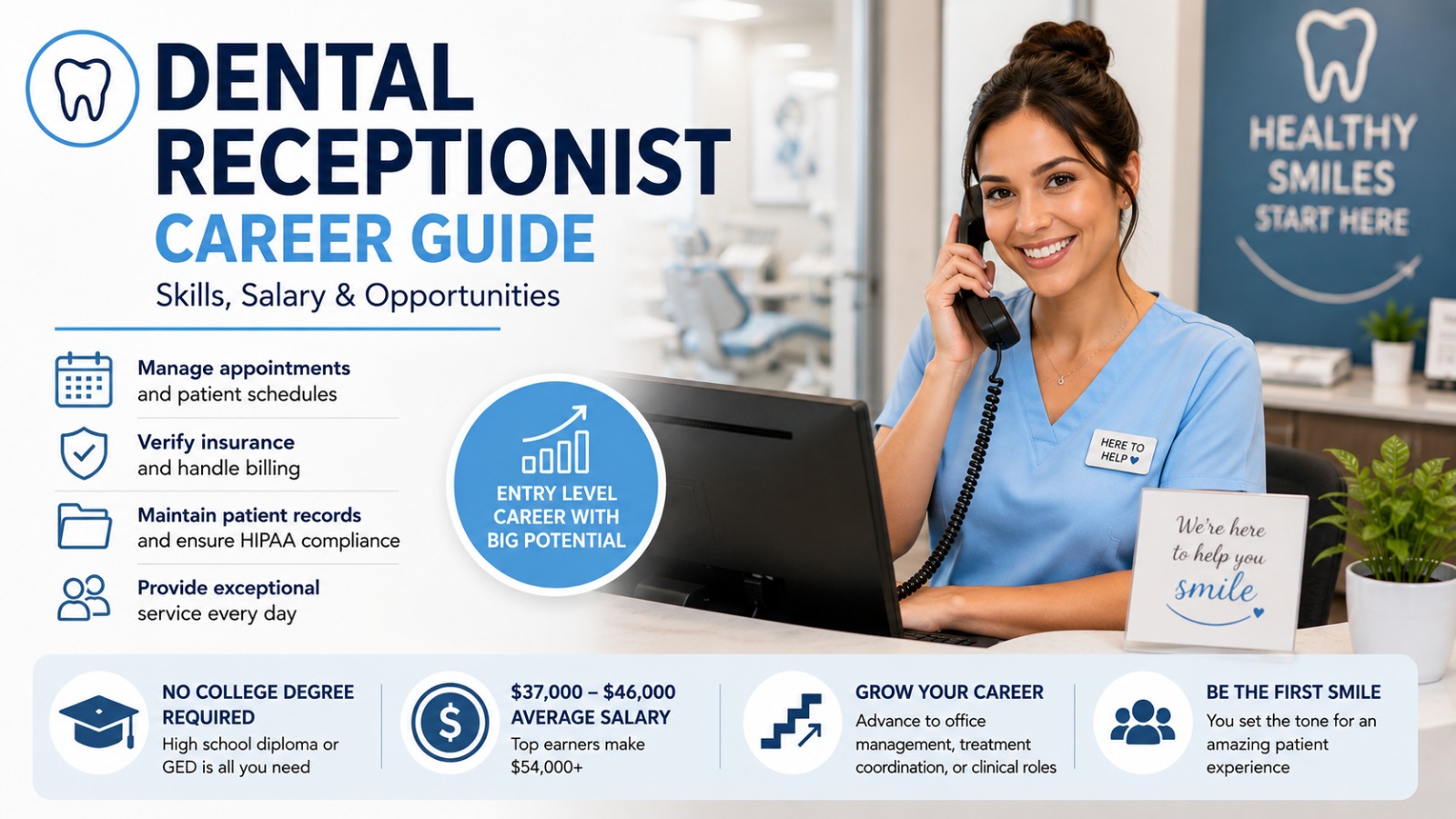
A dental receptionist manages the front desk of a dental practice — scheduling appointments, handling billing, verifying insurance, maintaining patient records, and serving as the first face patients see. It’s an entry-level role that requires no college degree, pays between $37,000 and $46,000 per year on average, and can grow into office management, treatment coordination, or even clinical careers.
Here’s what you need to know, whether you’re starting out or aiming to advance.
What Does a Dental Receptionist Actually Do?
A dental receptionist keeps the entire dental front office running smoothly. On any given day, that means:
-
Welcoming patients and checking them in
-
Scheduling, confirming, and managing patient recall appointments.
-
Verifying dental insurance eligibility before appointments
-
Managing patient records and ensuring HIPAA compliance
-
Processing billing, collecting co-pays, and handling insurance claims
-
Answering phones and responding to patient questions
-
Coordinating referrals and communicating between patients and the clinical team
Basically, clinical staff focus on treatments, while the front office ensures everything else runs smoothly.
What Does a Typical Day Look Like for a Dental Receptionist?
Here’s a realistic snapshot of a morning at the front desk:
You arrive before the first patient, pull up the day’s schedule in Dentrix or Eaglesoft, and confirm that insurance has been verified for each appointment. Patients start arriving — you check them in, update any changed information, and let the clinical team know. Between arrivals, you’re answering phones, rescheduling a cancellation, processing yesterday’s billing, and following up on an outstanding insurance claim. By mid-morning, you’ve touched every part of the practice without stepping into a single treatment room.
It’s a role that demands focus, warmth, and the ability to switch tasks quickly — sometimes all at once.
Do You Need a Degree to Become a Dental Receptionist?
No. A high school diploma or GED is all that’s required to get started — even with no prior dental experience.
That said, a few extra steps will make you a stronger candidate and help you land your first role faster:
Step 1: Earn your high school diploma or GED. This is the baseline requirement at virtually every dental practice.
Step 2: Get some relevant training. An associate degree or certificate in office administration, medical administration, or dental reception isn’t mandatory — but it helps. Community colleges and vocational schools offer short programs covering dental terminology, billing basics, and practice management software.
Step 3: Get familiar with dental software. Practices commonly use tools like Dentrix, Eaglesoft, and Open Dental. Even basic familiarity puts you ahead of other applicants. The broader category — dental practice management software — is a skill worth calling out on any resume.
Step 4: Add a few certifications. CPR certification and HIPAA compliance training are low-cost, quick to complete, and frequently listed in job postings as preferred qualifications.
Step 5: Apply and learn on the job. Most practices provide on-the-job training. You’ll spend the first few weeks learning their specific systems, workflows, billing policies, and CDT coding conventions. Ask questions. Take notes. This period matters more than most people realize.
Can You Become a Dental Receptionist With No Experience?
Yes — and it’s one of the more accessible entry points into healthcare.
Many dental practices hire candidates with strong customer service or administrative backgrounds and train them on the clinical side. If you’ve worked in retail, hospitality, or any front-facing role, those communication and organizational skills transfer directly.
What helps most when you have no dental experience: basic familiarity with medical or dental terminology, any exposure to scheduling or billing software, and genuine comfort with people who may be anxious or nervous about their appointment.
What Skills Does a Dental Receptionist Need?
You don’t need clinical training, but you do need a specific mix of people skills and administrative ability.
Can you communicate clearly and calmly?
This is the single most important skill. You’ll talk to nervous patients, busy dentists, insurance representatives, and vendors — often all in the same hour. You need to be clear, professional, and warm across all of them.
Patients are often anxious about dental visits. A calm, friendly greeting at the front desk genuinely changes their experience before they’ve sat down.
Are you organized enough to juggle multiple things at once?
Dental offices move fast. You’ll be managing appointment books, updating patient records, processing payments, collecting co-pays, and answering the phone—sometimes simultaneously. One scheduling error can throw off an entire day for the practice.
Strong organizational skills and attention to detail aren’t optional here. They’re the job.
Do you understand billing, insurance, and dental codes?
You don’t need to be an accountant. Still, you do need to understand how dental insurance verification works, how to file claims correctly using CDT codes, and how to process patient payments and handle billing disputes. Errors in this area affect both the practice’s revenue and patient trust.
Are you comfortable with dental practice management software?
Dental receptionists regularly use tools like Dentrix, Eaglesoft, and Open Dental — alongside payment processors, phone systems, and digital record platforms. Knowing these tools by name and being able to learn new ones quickly is a genuine competitive advantage.
Can you stay professional under pressure?
Dental offices have busy periods, Monday mornings, post-holiday rushes, and days when staff call in sick. Staying calm, solutions-focused, and professional during those moments is what separates good receptionists from great ones. According to the American Dental Association’s guidance on dental team roles, the front desk team directly shapes patient retention and overall practice health, which means pressure comes with the territory.
How Much Does a Dental Receptionist Earn?
Based on current 2025–2026 data across major salary platforms, the realistic average salary for a dental receptionist in the U.S. falls between $37,000 and $46,000 per year, with top earners at larger or urban practices reaching $54,000+.
Glassdoor’s May 2026 data puts the average at $46,428 per year, with a typical range of $40,345 to $54,070 annually. ZipRecruiter places the average closer to $38,966, with most salaries falling between $33,000 and $43,500.
The variance comes down to location, years of experience, practice size, and whether the practice is independently owned or part of a larger Dental Service Organization (DSO). DSO-affiliated practices often offer more structured pay scales and benefits.
To give you a fuller picture of where this role can lead financially:
|
Role |
Typical Annual Salary |
|
Dental Receptionist (entry) |
$33,000 – $40,000 |
|
Dental Receptionist (experienced) |
$40,000 – $54,000 |
|
Treatment Coordinator |
$36,000 – $62,000 |
|
Insurance & Billing Specialist |
$37,000 – $74,000 |
|
Dental Office Manager |
$42,000 – $76,000 |
|
Dental Hygienist |
$80,000 – $112,000 |
The front desk is a starting point, not a ceiling.
What Career Paths Are Open to Dental Receptionists?
This is where things get interesting. Most people don’t realize how many doors this role can open, both in administration and clinical work.
Want to stay in administration and move up?
Office Manager — You’ll oversee daily operations, supervise front desk staff, manage treatment plans, monitor billing, and ensure regulatory compliance. Most dental office managers started exactly where you’re starting.
Treatment Coordinator — You’ll bridge the gap between clinical recommendations and patient decisions. This means presenting treatment plans, explaining insurance coverage, and helping patients understand and commit to their care. Strong communicators thrive here.
Insurance and Billing Specialist — If you enjoy the financial and technical side, this role focuses entirely on filing claims, applying CDT codes, and managing the full billing cycle for the practice.
Want to move into clinical work?
Your time at the dental front office gives you a genuine head start — you already understand how a practice operates, know the terminology, and have real patient experience. From there:
Dental Assistant — A 9–12 month CODA-accredited program gets you chairside. According to the BLS, employment of dental assistants is projected to grow 6 percent from 2024 to 2034, faster than average, with about 52,900 openings projected each year.
Dental Hygienist — The bigger investment: a 2–3 year associate degree, national board exams, and state licensure. The BLS reports the median annual wage for dental hygienists was $94,260 in May 2024, with employment projected to grow 7 percent through 2034. Worth every step if clinical work appeals to you.
What’s the Difference Between a Dental Receptionist and a Dental Assistant?
A simple way to think about it: receptionists work the front of the practice, assistants work the back.
Receptionists handle administrative duties — scheduling, billing, insurance verification, patient recall, and front office communication. Dental assistants support clinical care — preparing treatment rooms, taking X-rays, assisting the dentist chairside, and giving patients post-care guidance.
In smaller practices, one person sometimes covers elements of both. But clinical assistant duties typically require additional accredited training and state certification. The BLS Occupational Outlook Handbook outlines the full distinction in detail if you want to compare both paths side by side.
Is Being a Dental Receptionist Stressful?
Honestly, it can be. It’s a high-contact, multi-tasking role in an environment where patients sometimes arrive anxious, schedules run behind, and insurance issues create friction.
That said, most experienced dental receptionists describe the role as satisfying rather than overwhelming—particularly because you see the direct impact of your work. When a nervous patient leaves smiling, or a billing dispute gets resolved cleanly, that’s a tangible result of your effort.
The practices that invest in good systems, clear workflows, and supportive teams make an enormous difference in how manageable the day-to-day feels. It’s worth asking about culture and systems in any interview.
How Do You Stand Out and Advance in This Role?
Once you’re in, these habits separate those who plateau from those who move up:
-
Learn the billing and coding side deeply — CDT codes, insurance verification, and claim follow-up. It’s the most transferable skill set in the practice.
-
Get comfortable with multiple software systems — Dentrix, Eaglesoft, and Open Dental. Versatility makes you indispensable.
-
Ask to shadow treatment coordinators or office managers — visibility and cross-training matter.
-
Stay current on changes — insurance coding updates, new HIPAA regulations, software upgrades
-
Find a mentor within the practice — someone who’s been doing this for years can compress your learning significantly.
Frequently Asked Questions
Do I need experience to get a dental receptionist job?
No. Many practices hire candidates with customer service or administrative backgrounds and train them on dental-specific systems. Strong communication skills and a willingness to learn matter more than prior dental experience at the entry level.
How long does it take to become a dental receptionist?
If you already have your high school diploma, you could start in a matter of weeks with on-the-job training. A certificate program in dental or medical administration typically takes 3–6 months and makes you a stronger candidate.
What’s the difference between a dental receptionist and a medical receptionist?
The core skills overlap significantly: scheduling, billing, records management, and patient communication. The key differences are dental-specific software (Dentrix vs. general EHR systems), dental insurance processes, and dental terminology, such as CDT codes and procedure names.
What software do dental receptionists use?
The most common platforms are Dentrix, Eaglesoft, and Open Dental. Most practices will train you on their specific system, but familiarity with any of them is a meaningful advantage.
Is being a dental receptionist a good career to start in healthcare?
Yes — especially as a foundation. It requires no degree, offers genuine career advancement into coordination, management, or clinical roles, and gives you hands-on exposure to how a healthcare practice operates from day one.