
You didn’t go into dental hygiene to burn out by 40. But between five-day weeks, packed patient schedules, and zero breathing room, that’s where a lot of RDHs end up. The good news? The market has shifted-and part-time dental hygiene work is more viable, more respected, and better compensated than it’s ever been, especially in Indiana, Michigan, and Tennessee.
Why Part-Time Dental Hygiene Is Growing
The short answer is that there aren’t enough hygienists to go around. According to the Bureau of Labor Statistics’ dental hygienist outlook, the field is projected to grow 7% through 2033, with roughly 15,300 openings annually. At the same time, the ADA reports that 33% of current hygienists are expected to retire within five years, with a median age of 51. 5. Federal data puts the current shortage at nearly 21,000 hygienists, growing to 30,000 by 2037. That gap gives working RDHs real leverage. Practices that once offered only full-time positions are now building schedules around hygienists – not the other way around. Two- and three-day-a-week arrangements, compressed hours, and per diem work are no longer the exception. They’re becoming a standard recruitment strategy.
Indiana: Strong Demand and Competitive Pay
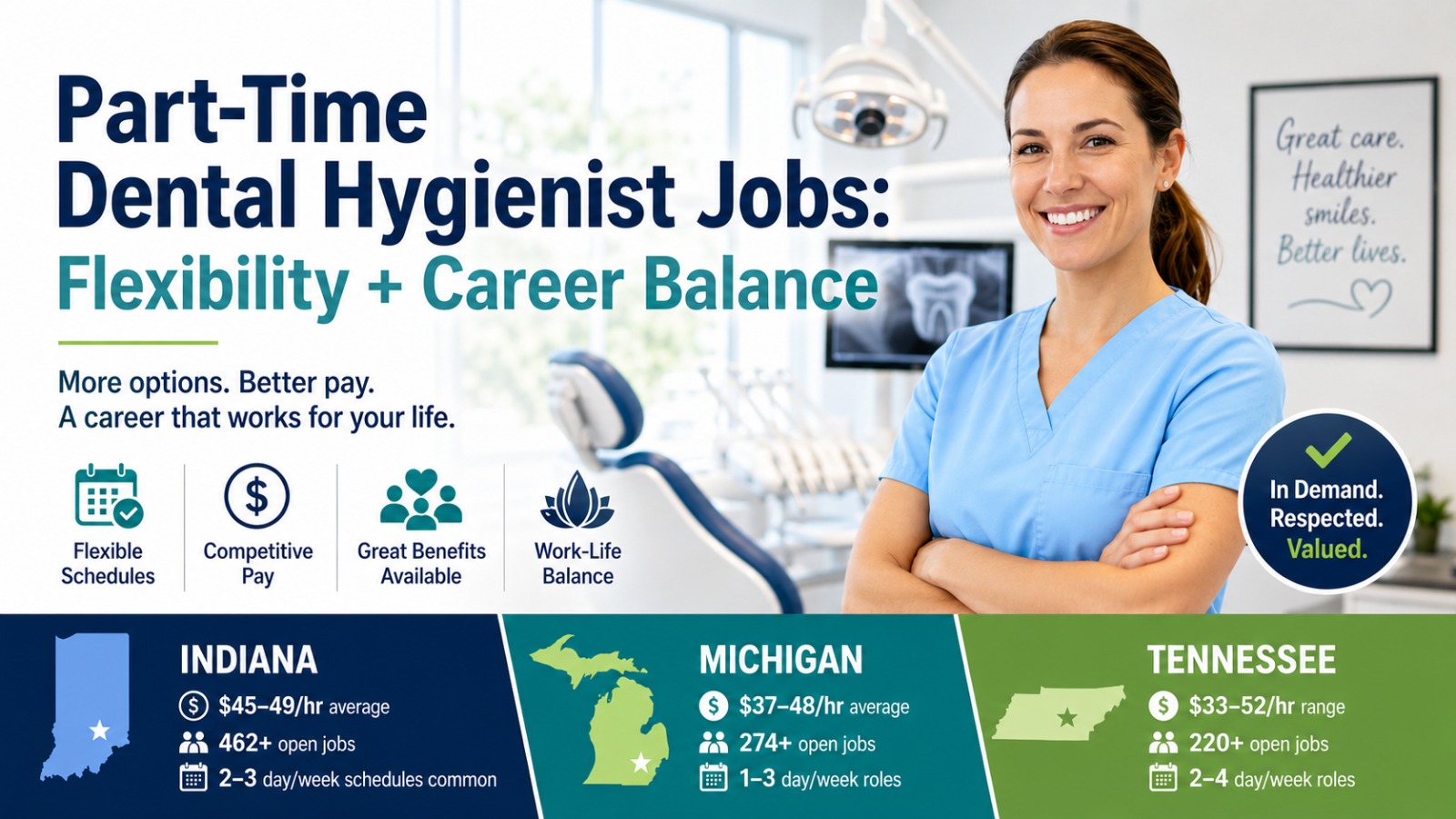
Indiana’s dental hygiene market is active across the board – not just in Indianapolis. There are currently 462+ hygienist job openings statewide, including in markets like Kokomo, Noblesville, Fort Wayne, and Carmel. Pay is strong. Salary data from Indeed puts the average hourly rate at $48.67, based on over 1,600 submissions. Part-time roles are well-structured; practices in Noblesville advertise “choose 2-3 days per week,” and many list weekday-only schedules with no evenings or weekends. Some Indianapolis-area practices advertise rates of up to $100/hour during peak demand, with sign-on bonuses of up to $5,000, even for part-time roles. Indiana snapshot: ~$45-49/hr average | 462+ openings | 2-3 day/week schedules common
Michigan: Flexible Schedules in a Competitive Market
Michigan – home to MPM Dental’s largest cluster of locations across Grand Rapids, Jenison, Portage, and Kalamazoo – is the most active of the three states for hygiene hiring. Glassdoor currently lists 274+ active hygienist openings in Michigan, with strong demand across the Grand Rapids corridor and metro Detroit. Average annual pay sits around $91,874, or roughly $44/hour, with experienced hygienists reaching $116,000+. Part-time is genuinely available here. Some West Michigan practices are actively recruiting RDHs for just one to two days per week. Larger group practices offer two- to three-day arrangements with consistent scheduling – no guessing week to week. Michigan snapshot: ~$37-48/hr average | 274+ openings on Glassdoor alone | 1-3 day/week roles actively posted
Tennessee: Growth Opportunities for RDHs
Tennessee’s dental market is expanding fast, particularly in the Nashville metro, where MPM Dental operates in Nashville, Bellevue, Franklin, and Germantown. A search of dental hygienist jobs in Tennessee on Indeed returns 220+ active openings, with notable demand in Franklin and Germantown, both high-growth suburban markets. Average pay runs around $79,837 annually ($38/hr), with top earners clearing $101,000. Nashville’s suburbs tend to track above the state average. Several Nashville-area practices list part-time hygienist roles for two to four days per week, Monday through Thursday, 8 a.m. to 5 p.m.-clean, predictable schedules with no weekend obligation. Some Franklin-area practices extend full benefits eligibility at 24 or more clinical hours per week. Tennessee snapshot: ~$33-52/hr range | 220+ openings | 2-4 day/week roles across Nashville suburbs
What Part-Time Dental Hygiene Actually Looks Like
“Part-time” isn’t one thing. Here are the three formats you’ll encounter most:
Set weekly schedules:
You agree on specific days – Tuesdays and Thursdays, for example – and that’s your week, every week. Predictable for you, reliable for the practice. Best fit for parents, caregivers, or anyone who needs a schedule they can actually plan around.
Per Diem or Fill-In Work:
You pick up shifts at different practices as needed. Platforms like Kwikly let hygienists book shifts consistently and build a reliable weekly rhythm while maintaining full schedule control. Great for supplementing income or testing out different practice environments before committing.
Compressed Clinical Hours:
Four-day weeks, early-end days, or 7:30 a.m.-2:30 p.m. blocks that feel part-time in lifestyle impact even if total hours are closer to full-time. Some Indiana practices offer exactly this, with paid vacation, paid holidays, and IRA matching included.
Can Part-Time Hygienists Still Get Benefits?
Yes – more often than most people expect. The workforce shortage has changed what practices are willing to offer. Across Indiana, Michigan, and Tennessee, part-time hygienist listings regularly include the following:
- 401(k) with employer matching
- Paid time off and paid holidays
- Continuing education reimbursement
- Uniform allowances
- Employee dental discounts
- Health insurance (typically at 24+ clinical hours/week)
Benefits eligibility varies by practice and hours worked – always confirm upfront. But the assumption that part-time means no benefits is outdated in today’s hiring market.
What to Look for in a Part-Time Dental Hygiene Job
Not all part-time roles deliver the balance they promise. Before accepting a position, dig into:
- Schedule consistency: Are your days guaranteed, or subject to last-minute cancellation?
- Patient pacing: 50-60 minutes per patient is the standard for quality care. Anything tighter is a red flag.
- Technology: Digital X-rays, intraoral scanners, and systems like Dentrix or Eaglesoft signal a well-run practice.
- Team culture: Part-time shouldn’t mean invisible. You should be included in team meetings and treated as a real member of the staff.
- CE support – Even in a limited role, continuing education reimbursement matters for your license and your long-term growth.
Why More Hygienists Are Prioritizing Work-Life Balance
Burnout in dental hygiene is real and well-documented. Repetitive strain, back-to-back patients, administrative pressure, and limited autonomy all contribute. Many experienced RDHs aren’t leaving the profession; they’re reconfiguring it. Part-time work is how a lot of hygienists stay in the field longer, stay healthier, and stay engaged with the work they trained for. And in a market short of tens of thousands of qualified hygienists, practices need to make that possible. The hygienists winning right now are the ones who know their value and negotiate accordingly.
Explore Careers With MPM Dental
MPM Dental supports a network of private practices across Indiana, Michigan, and Tennessee. Our model removes the administrative pressure from dental teams so that hygienists and clinicians can focus on actual patient care – not scheduling chaos or insurance headaches. If you’re an RDH looking for a part-time role with a practice that respects your time or a practice owner who wants to build a sustainable hygiene team, we’d like to talk. Browse open positions at MPM Dental or reach out at info@mpmdental.com.
FAQs
Are part-time dental hygienists in demand?
Yes – significantly. With a national shortage projected to reach 30,000 hygienists by 2037, practices across Indiana, Michigan, and Tennessee are actively recruiting part-time RDHs and offering competitive pay and benefits to fill open schedules.
How much do part-time dental hygienists make?
It varies by state and experience. In Indiana, the average is around $45-49/hr. Michigan averages $37-48/hr. Tennessee ranges from $33-52/hr, depending on the market and employer. Many part-time roles pay the same hourly rate as full-time positions.
Can dental hygienists work flexible schedules?
Absolutely. Set weekly days, per diem shifts, and compressed four-day weeks are all common arrangements in today’s market. Practices are increasingly willing to build around hygienist availability rather than requiring rigid full-time commitments.
Do part-time hygienists receive benefits?
Many do. Benefits eligibility has expanded alongside the hiring shortage. Common offerings include 401(k) matching, PTO, CE reimbursement, and health insurance at 24+ clinical hours per week. It varies by employer, so always ask before accepting.
Which states have the strongest demand for RDHs?
Indiana, Michigan, and Tennessee all have strong and growing demand. Indiana leads with 462+ current openings; Michigan follows with 274+ listed on Glassdoor alone; and Tennessee has 220+ active postings-particularly in the Nashville metro area.