

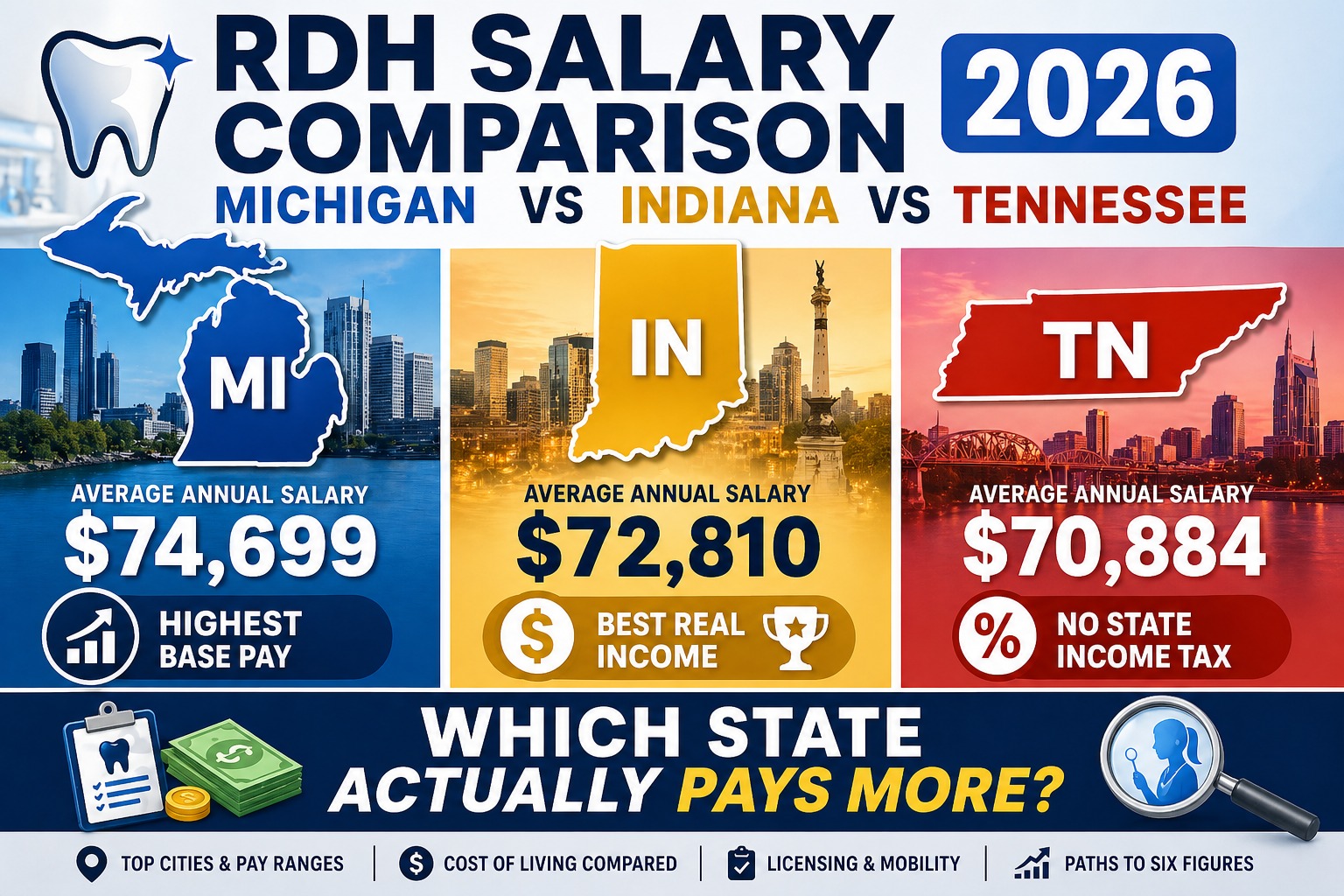
Where you choose to practice as a registered dental hygienist is one of the most consequential financial decisions of your RDH career. According to the U.S. Bureau of Labor Statistics, the national average dental hygienist salary is $94,260-but Michigan, Indiana, and Tennessee all sit below that benchmark. What matters is not just the gross number: cost of living, state income tax, scope-of-practice rules, and local market demand all determine what you actually take home.
This guide breaks down average annual and hourly wages, city-by-city pay, percentile ranges, cost-of-living-adjusted purchasing power, licensing considerations, and the real paths to six-figure income across all three states-with an eye toward where MPM Dental’s own practices are hiring right now.
Average Registered Dental Hygienist Salary by State (2026)
| State | Avg Annual Salary | Avg Hourly Rate | vs. National ($94,260) | |
| Michigan | $74,699 | $35.91/hr | -21% | |
| Indiana | $72,810 | $35.00/hr | -23% | |
| Tennessee | $70,884 | $34.08/hr | -25% | |
| National Avg | $94,260 | $45.32/hr | – |
Michigan leads in base dental hygienist salary, but the gap narrows considerably once taxes and housing costs enter the picture. Active employer listings in Michigan metro markets regularly run above the reported annual average, reflecting real-time hiring demand in Grand Rapids, Detroit, and surrounding suburbs.
Cost-of-Living Adjusted RDH Salary: Which State Pays More in Real Terms?
Raw salary tells only half the story. The table below adjusts each state’s average registered dental hygienist salary against estimated living costs and state income tax
| State | Avg RDH Salary | Est. Living Cost | Real Surplus | After-Tax Surplus |
| Michigan | $74,699 | ~$38,000 | $36,699 | ~$33,672 |
| Indiana | $72,810 | ~$34,500 | $38,310 | ~$35,628 |
| Tennessee | $70,884 | ~$36,200 | $34,684 | ~$34,684 |
Indiana wins on real purchasing power despite its lower nominal salary. Lower housing costs, low property taxes, and a 3% income tax rate leave more discretionary income than in Michigan in most scenarios.
Tennessee’s zero state income tax saves approximately $2,400/yr vs. Indiana and $3,240/yr vs. Michigan on an $80,000 salary – partially closing the base-pay gap.
Dental Hygienist Salary by City: Top Markets in Michigan, Indiana, & Tennessee
Choosing the right city often matters more than choosing the right state. Metro markets with strong private-practice demand, specialty offices, and competitive hiring outpay rural markets by $5,000-$15,000 annually.
| City | State | Avg Annual Salary | Avg Hourly | Top Earners (90th %ile) |
| Hamilton | Michigan | $94,591 | $45.48/hr | $116,000+ |
| Detroit | Michigan | $87,080 | $41.87/hr | $92,521+ |
| Grand Rapids | Michigan | $72,513 | $34.86/hr | $88,000+ |
| Carmel / Fishers | Indiana | $91,500-$94,200 | $44-$45/hr | $113,000+ |
| Indianapolis | Indiana | $90,100 | $43.32/hr | $89,000+ |
| Brentwood / Franklin | Tennessee | $91,400-$92,100 | $43.94-$44.28/hr | $101,000+ |
| Nashville | Tennessee | $90,500 | $43.51/hr | $87,000+ |
A dental hygienist in Carmel, Indiana, earns roughly the same as one in Detroit, with significantly lower housing costs and a lower state income tax rate. MPM Dental has active practices in several of these high-paying markets, including Grand Rapids (MI), Kokomo and Mishawaka (IN), and Nashville, Franklin, and Bellevue (TN).
RDH Salary Range by Percentile
State averages mask wide variation across experience levels, office types, and metro vs. rural markets.
| Percentile | Michigan | Indiana | Tennessee |
| 10th (entry floor) | $46,127 | $47,411 | $36,305 |
| 25th | $79,300 | $81,500 | $69,000 |
| 50th (median) | $91,701 | $94,431 | $79,837 |
| 75th | $104,200 | $107,100 | $90,800 |
| 90th (top earners) | $116,701 | $119,949 | $101,653 |
The counterintuitive finding: Indiana’s 90th-percentile ceiling of $119,949 exceeds Michigan’s $116,701. For high-performing registered dental hygienists in top metro markets, Indiana’s earning ceiling is the highest of these three states – a fact that gets overlooked when comparing only state averages.
Michigan Dental Hygienist Salary: Key Facts
Michigan RDH Average: $74,699/yr ($35.91/hr) | 90th percentile: $116,701
Michigan offers the highest gross income and the most active hiring market of the three states. Metro placements in Detroit and Grand Rapids frequently reach $50-$65/hr for experienced hygienists. Michigan’s Public Act 161 also allows dental hygienists to practice in public or nonprofit facilities – expanding community-based career opportunities beyond traditional private practice.
MPM Dental operates practices in Grand Rapids and Jenison, MI – two of the state’s strongest markets for RDH compensation and career development.
Indiana Dental Hygienist Salary: Key Facts
Indiana RDH Average: $72,810/yr ($35.00/hr) | 90th percentile: $119,949 – the highest of the three states
Indiana’s registered dental hygienist salary is only $1,889/yr below Michigan’s – a gap that cost-of-living advantages quickly close. Median home values in Indiana are approximately 45% below the national median, and property taxes are among the lowest in the Midwest.
New graduates entering the Indiana market report initial offers of $42-$57/hr, with Indianapolis suburbs (Carmel, Fishers, and Whitestown) averaging $91,500-$94,200. Indiana’s Access Practice Agreement also allows dental hygienists to provide preventive services in certain settings without prior dentist authorization – a scope-of-practice advantage that expands career flexibility.
MPM Dental has practices in Kokomo and Mishawaka, IN – both strong markets for RDH roles with room for career advancement.
Tennessee Dental Hygienist Salary: Key Facts
Tennessee RDH Average: $70,884/yr ($34.08/hr) | 90th percentile: $101,653
Tennessee charges no state income tax on wages – on an $80,000 dental hygienist salary, that saves approximately $2,400/yr vs. Indiana and $3,240/yr vs. Michigan. Nashville’s suburbs lead the state: Brentwood ($92,100) and Franklin ($91,400) are the fastest-growing dental markets. Flexible and part-time scheduling arrangements are also more common in Tennessee’s practice culture.
MPM Dental has a strong presence across Nashville, Franklin, and Bellevue, TN – all three of the state’s highest-paying markets. If you’re considering a move to Tennessee, our team can help you land in the right practice.
Tennessee and the DDH Compact: A Career Mobility Advantage
Tennessee is already a member of the Dentist and Dental Hygienist (DDH) Compact, alongside Maine, Kansas, Virginia, Washington, Iowa, and Wisconsin. Once fully implemented, Tennessee-licensed RDHs can practice across all member states without a separate license – including Washington state, where dental hygienists average $123,510/yr.
Michigan and Indiana are not yet DDH Compact members. For RDHs interested in cross-state career flexibility or travel hygiene, Tennessee’s compact membership is a structural advantage that no salary figure alone captures.
Can Dental Hygienists Make Six Figures in Michigan, Indiana, or Tennessee?
Yes – and more commonly than state averages suggest. The clearest paths to $100,000+ as a registered dental hygienist include:
- Specialty or periodontal practices, which routinely pay $5-$15/hr above general dentistry
- Production bonus systems at group practices that reward efficiency and patient volume
- Advanced certifications – local anesthesia, laser therapy, expanded functions – adding $2-$5/hr above peers
- Assisted hygiene models (two chairs, one RDH) that significantly increase daily production
- Per-diem and flexible staffing roles in metro markets
Six figures is realistic within 3-5 years in Michigan, 4-6 years in Indiana, and 6-8 years in Tennessee for hygienists who position themselves in competitive metro markets and pursue advanced certifications.
Dental Hygienist Licensing and Relocation: What to Check
No automatic reciprocity exists between Michigan, Indiana, and Tennessee. Before accepting a registered dental hygienist position in a new state, verify the following with your destination state board:
- License endorsement timeline and fees
- Local anesthesia and expanded-function rules
- Nitrous oxide continuing education requirements
- Temporary permit availability during the transition
- DDH Compact membership status
The ADHA licensure page is the best starting point – always verify current requirements directly with the Michigan Board of Dentistry, Indiana State Board of Dentistry, or Tennessee Board of Dentistry before relocating.
Head-to-Head Summary: Michigan vs. Indiana vs. Tennessee RDH Salary
| Factor | Michigan | Indiana | Tennessee |
| Avg base salary | $74,699 | $72,810 | $70,884 |
| 90th percentile ceiling | $116,701 | $119,949 | $101,653 |
| State income tax | 4.05% | 3% | None |
| Median home price | ~$225,000 | $222,516 | $294,786 |
| Temp / per-diem market | Very strong | Moderate | Moderate |
| DDH Compact member | No | No | Yes |
| Six-figure timeline | 3-5 yrs | 4-6 yrs | 6-8 yrs |
| Best for | Max salary & temp | Affordability & new grads | Tax savings & lifestyle |
Frequently Asked Questions
Which state pays dental hygienists the most?
Michigan leads in the average dental hygienist salary at $74,699 annually. However, Indiana leads on the 90th-percentile ceiling at $119,949 – meaning high-earning, experienced RDHs in Indiana’s top metro markets can out-earn their Michigan counterparts.
Can dental hygienists make six figures in Michigan, Indiana, or Tennessee?
Yes, most realistically through specialty practices, production bonus systems, and advanced certifications. Michigan and Indiana are the most accessible paths, with six figures achievable within 3-6 years for hygienists who position themselves in metro markets.
Can a new dental hygienist graduate earn $50 per hour?
Yes – particularly in competitive metro markets. New RDH graduates in Indiana and Michigan regularly report initial offers of $42-$57/hr in suburbs like Carmel, Fishers, Grand Rapids, and the Detroit metro area.
What is the DDH Compact, and how does it affect dental hygienist careers?
The DDH Compact is an interstate licensure agreement allowing dental hygienists in member states to practice across all participating states without a separate license. Tennessee is already a member; Michigan and Indiana are not yet. For RDHs interested in career mobility, Tennessee’s membership is a meaningful long-term advantage.
What should I check before relocating for a dental hygienist job?
License endorsement requirements, local anesthesia and expanded-function rules, nitrous oxide CE hour requirements, temporary permit availability, and DDH Compact status. Always verify with your destination state board – the ADHA licensure page is the best starting point.